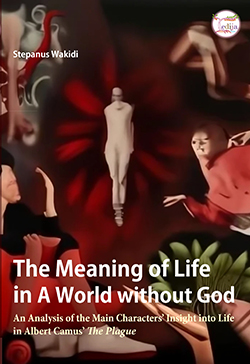
The Meaning of Life in A World without God
Spesifikasi
| Kode | : | 320008 |
| Judul | : | The Meaning of Life in A World without God An Analysis of the Main Characters’ Insight into Life in Albert Camus’ The Plague |
| Penulis | : | Stepanus Wakidi |
| Tahun Terbit | : | 2025 |
| ISBN | : | 978-623-7421-76-4 [KDT] |
| ISBN PDF | : | 978-623-7421-75-7 |
| Tebal | : | 318 (xii+306) halaman |
| Ukuran | : | 14.5x21 cm |
| Harga | : | Rp150.000 |
Jika Anda tertarik untuk menerbitkan buku serupa, silakan kunjungi ketentuan Penerbitan Buku!
Deskripsi
An Analysis of the Main Characters’ Insight into Life in Albert Camus’ The Plague
By Stepanus Wakidi (2025)
In a world increasingly shaped by unpredictability, crisis, and existential uncertainty, the quest for purpose remains one of humanity's most profound endeavors. The Meaning of Life in A World without God, authored by Stepanus Wakidi and published in 2025, offers a brilliant, multi-layered philosophical and literary exploration of this search. Drawing from Albert Camus’ masterpiece The Plague (La Peste), Wakidi uses the backdrop of a quarantined city to dissect how human beings construct, preserve, or abandon meaning when confronted with absolute absurdity, suffering, and the omnipresence of death.
The book is structured into a rigorous framework that seamlessly bridges existential philosophy, literary criticism, and contemporary societal observation. Spanning 318 pages, Wakidi’s analysis begins by examining the core tenets of atheistic existentialism, contrasting Camus’ philosophical methodology with thinkers like Jean-Paul Sartre and Friedrich Nietzsche. By carefully unpacking concepts such as the Absurd, philosophical suicide, metaphysical rebellion, and the distinction between vertical and horizontal transcendence, the author builds a robust theoretical foundation. He then applies these philosophical lenses to an in-depth structural analysis of The Plague, focusing on its plot, spatial and spiritual settings, and, most crucially, its rich cast of characters.
At the heart of the book is an exhaustive evaluation of how Camus’ main characters react to the terrifying outbreak of the epidemic in Oran. Wakidi meticulously analyzes the unique coping mechanisms and existential insights of each figure: Dr. Bernard Rieux, who embodies horizontal transcendence and active resistance through relentless medical duty; Jean Tarrou, the secular saint searching for peace and moral purity without God; Joseph Grand, the humble clerk whose routine becomes a quiet, resilient rebellion; Father Paneloux, the Jesuit priest who struggles to reconcile faith with innocent suffering; Raymond Rambert, the journalist who shifts from selfish escapism to collective solidarity; and Cottard, who exploits the misery of quarantine for personal gain. Through these diverse psychological archetypes, Wakidi presents a rich spectrum of human responses to a crisis where divine intervention is absent.
Beyond academic literary analysis, Wakidi’s work shines in its striking contemporary relevance. The author draws a poignant parallel between the quarantined, plague-stricken Oran and the modern Indonesian socio-political landscape. He argues that today's national climate—frequently dominated by volatile, short-term practical political interests—has fostered an environment of social uncertainty, moral vacuum, and collective anxiety akin to an epidemic-induced quarantine.
The Meaning of Life in A World without God is an invaluable resource for students, researchers, and general readers interested in philosophy, literature, and sociology. Wakidi successfully demonstrates that Camus’ message is not one of nihilistic despair, but of profound hope: in a silent universe, human solidarity, rebellion against suffering, and the simple act of doing one’s duty are the ultimate sources of light. It stands as a powerful reminder that even in our darkest hours, we possess the autonomy to define our own meaning.
Daftar Isi
- Preface .... v
- Table of Contents .... ix
- Questioning The Meaning of Life .... 1
- The Routine of Life .... 1
- Human Sufferings and Death .... 3
- Other-worldly versus This-worldly Point of Views .... 4
- Camus’ The Plague and Its Relevance .... 6
- Politics Takes Precedence .... 7
- I Rebel, Therefore We Exist .... 8
- Studying Camus’ Search for Meaning .... 9
- Albert Camus: His Life and Works .... 11
- Biographical Sketch .... 11
- Camus’ Writings .... 24
- Essays .... 25
- Novels .... 27
- Short Stories .... 31
- Plays .... 31
- Philosophical and Objective Approaches in Literary Study .... 35
- Literary Approach .... 35
- Philosophical Approach .... 36
- Objective Approach .... 36
- The Theory of Plot .... 37
- The Theory of Setting .... 39
- The Theory of Characters .... 40
- Atheistic Existentialism .... 43
- Atheistic Existentialism .... 43
- Phenomenology .... 44
- Sartre’s etre-pour-soi and etre-en-soi .... 46
- Nietzsche’s Superman .... 48
- Camus’ Philosophical Thoughts .... 50
- Camus’ Methodology of Philosophizing .... 50
- The Absurd .... 53
- Philosophical Suicide .... 57
- Repetition, Consciousness, Intensity .... 58
- The Revolt .... 60
- Metaphysical Rebellion and the Denial of God .... 64
- Sade’s Rebellion .... 66
- The Romantics’ Rebellion .... 67
- Ivan Karamazov’s Nihilism .... 67
- Nietzsche’s Prophetic Nihilism .... 68
- Historical Rebellion: Horizontal Transcendence .... 68
- Rebellion Has Become Revolution .... 69
- French Revolution: Replacing Vertical with Horizontal Transcendence .... 70
- Russian Communism: History Has Become a New Religion .... 71
- Rebellion Has Become Terror and Murderous .... 73
- Moderation .... 74
- Critical Review of The Plague .... 77
- Subject Matter, Approach and Procedures .... 81
- Subject Matter .... 81
- Approach .... 81
- Procedures .... 84
- Structural Analysis: Plot, Setting, and Characters .... 88
- The Plot .... 89
- Setting .... 138
- Physical Settings .... 140
- Time Setting .... 140
- Place Setting .... 140
- Spiritual Setting .... 151
- Living under The Plague .... 153
- Characters .... 173
- Dr. Bernard Rieux .... 174
- Jean Tarrou .... 198
- Joseph Grand .... 209
- Father Paneloux .... 216
- Raymond Rambert .... 224
- Monsieur Cottard .... 231
- Other Characters .... 237
- Old Spaniard Patient with Asthma .... 237
- M. Othon .... 238
- Rieux’s mother .... 240
- Castel .... 241
- The Eccentric Old Man .... 242
- Rieux’s wife .... 242
- The Hotel Manager .... 243
- Richard .... 243
- Mercier .... 244
- M. Michel .... 244
- The Night Watchman .... 244
- Camps .... 244
- Smugglers .... 244
- Situation of Life Described in The Plague .... 246
- Summary .... 257
- The Reaction of The Main Characters to The Situation of Life .... 260
- Cottard .... 260
- Tarrou .... 263
- Rambert .... 267
- Paneloux .... 269
- Rieux .... 271
- Grand .... 276
- Other Characters .... 276
- Summary .... 277
- The Meaning of Life in A World Without God .... 281
- Summary .... 287
- Bibliography .... 290
- Appendix: The Synopsis of The Plague .... 302
Jika Anda tertarik untuk menerbitkan buku serupa, silakan kunjungi ketentuan Penerbitan Buku!